Waste Carrier Registrations Have More Than Tripled Since Digital Waste Tracking Went Live
Robert Whiteside
CEO and Founder, Wasters
New waste carrier registrations in England have more than tripled since digital waste tracking went live on 1 October, after climbing through the second half of September. We've analysed the Environment Agency's register to show who is registering and what it means for your business.
What changed on 1 October
From 1 October 2026, permitted sites that receive waste in England and Wales must record every load on DEFRA's digital waste tracking service within two working days. Each record includes the carrier's details, with their carrier registration number or the reason they don't need one.
If the carrier has no registration number, the site has to pick one of only four reasons:
On site: the waste is only moving within the same premises.
Household: a householder taking their own household waste, not for profit.
One-off: a one-off or occasional journey by someone who doesn't normally and regularly carry waste.
Marine: waste moved by vessel under a marine licence or exemption.
None of these fits a business that delivers loads every week. A site taking several loads a day from a carrier with no registration number would have to record one of these reasons against every load, in a record that goes to the regulator. That draws a clear line between a householder dropping off their own rubbish and a business carrying waste for a living.
Carrier registration itself isn't new. Businesses that transport waste have needed to register for many years, with a few narrow exemptions. What's new is that the site receiving each load now reports the carrier's registration number to the regulator, load by load. Carriers don't have to use the service themselves yet. The sites they deliver to now need their number.
What the register shows
We download the Environment Agency's public register of waste carriers, brokers and dealers every day, so we see each new registration the morning after it's made.
Through most of 2026, new registrations ran a little ahead of last year. They were about 10% higher from January to August, and about a fifth higher over the summer.
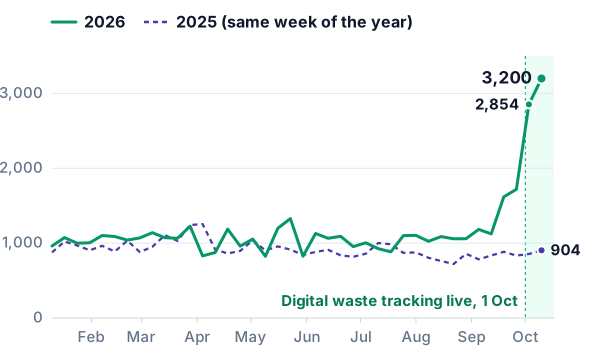
From mid-September they climbed sharply. The two weeks before go-live saw nearly twice as many new registrations as the same weeks of 2025. In the week that included 1 October, 2,854 businesses registered as carriers in England, against 855 in the same week last year.
The week after go-live was busier still. In the week to 10 October, 3,200 businesses registered, against 904 in the same week last year. From Monday to Friday that was about 570 a working day, against fewer than 200 on the same days last year.
New carrier registrations in England per week (Sunday to Saturday), plotted at the end of each week. 2025 is shown against the same week of the year. Renewals are excluded. Source: Environment Agency public register of waste carriers, brokers and dealers; Wasters analysis.
Before, during and after go-live
New carrier registrations in England per week. Each 2025 figure covers the same days of the week a year earlier.
Summer, 1 July to 12 September (average week): 848 in 2025, 1,051 in 2026. About a fifth higher.
Run-up, 13 to 26 September (average week): 859 in 2025, 1,669 in 2026. Nearly double.
Go-live week, 27 September to 3 October: 855 in 2025, 2,854 in 2026. 3.3 times as many.
Week after, 4 to 10 October: 904 in 2025, 3,200 in 2026. 3.5 times as many.
The register as a whole shows the same thing. The Environment Agency's published register grew by 2,411 and then 2,766 in the last two weeks, against 460 to 830 a week over the summer.
Who is registering
The register also shows who these businesses are. We compared registrations made from 28 September to 10 October with those from 3 August to 11 September.
The rise is in new registrations. Renewals have held steady at around 300 to 450 a week all summer and autumn.
The businesses are new to the register. Among companies registering, the share that already held a carrier registration fell from 9.4% to 6.1%.
Most are established businesses. Among companies registering, 74% were incorporated more than two years ago, up from 66%. The share formed in the last year fell from 24% to 17%.
More are sole traders. They make up 53% of new registrations, up from 44%.
The mix of tiers has shifted slightly. Upper tier, which covers anyone carrying other people's waste, has fallen from 48% to 45% of new registrations. The rest register as lower tier, which mainly covers businesses carrying only their own.
The register can't tell us what these businesses were doing before they registered. The profile fits businesses that were already moving waste and are registering now because the sites they deliver to need a registration number for every load, and none of the four reasons fits a regular business. Some will be businesses that have only just found out they need one, and some will be registering to be on the safe side.
Wales tells the same story on a smaller scale
Wales brought in digital waste tracking on the same day, under its own regulations. Its register is much smaller, with about 50 new carrier registrations in a normal week against around 1,000 in England. Natural Resources Wales also publishes its register less often, so our Welsh figures run to 7 October.
New registrations in Wales were much the same as 2025 from January to August, and edged up in mid-September. Then, in the go-live week, 134 businesses registered against 42 in the same week last year. That's more than three times as many, almost exactly the jump we see in England. In the first four days of the following week, 81 more registered, already nearly double the 43 for the whole of the same week last year.
What it means for your business
If you receive waste, expect to see carrier registration numbers you don't recognise. A registration made this week is as valid as one made years ago. When a carrier is new to you, check their number on the public register. If a carrier who delivers regularly can't give you a number, none of the four reasons will fit. New registrations appear in the published register data the day after they're made. Wasters refreshes its copy of the register every morning and alerts you if a carrier in your supply chain changes status.
If you hand waste to a carrier, your duty of care is unchanged. Ask for their registration number and check it. The difference now is that the site receiving your waste records that number with the regulator.
If you carry waste and aren't registered, the sites you deliver to now need your registration number for every load, and carrying waste without registering can bring an unlimited fine. Registration is usually free if you only carry waste you produce yourself. Register with the Environment Agency in England, or with Natural Resources Wales if your business is in Wales.
What to watch
Seven working days after go-live, it's too early to say whether this is a one-off wave of catch-up registrations or a lasting rise. If it's a catch-up, weekly numbers should peak and then fall back towards around 1,000 over the coming weeks.
Scotland and Northern Ireland are due to introduce digital waste tracking in January 2027, so a similar rise there is likely as that date approaches. We now track Scotland's register daily, so we'll be able to see whether that happens. We'll update these figures as more weeks come in.
How we measured this
Our source is the Environment Agency's public register of waste carriers, brokers and dealers, which Wasters downloads every day, together with the Natural Resources Wales register. We count new registration numbers by the date the regulator registered them. A renewal keeps its original registration number, which lets us leave renewals out. As a cross-check, new registrations minus removals each week matches the growth in the size of the Environment Agency's published file to within a dozen.
Figures for 2025 count registrations that are still on the register today, so they slightly understate last year. A second method counts every registration number issued, including any cancelled since. On that measure, go-live week is 3.2 times last year rather than 3.3, and the week after is 3.3 times rather than 3.5. Either way, new registrations have more than tripled, and every conclusion here still holds. England figures run to 10 October 2026 and Wales to 7 October 2026.