Regulations28 April 20264 min
Let's clarify what a "waste receiving site" actually means.

Mal Rigoli
Co-Founder, Wasters
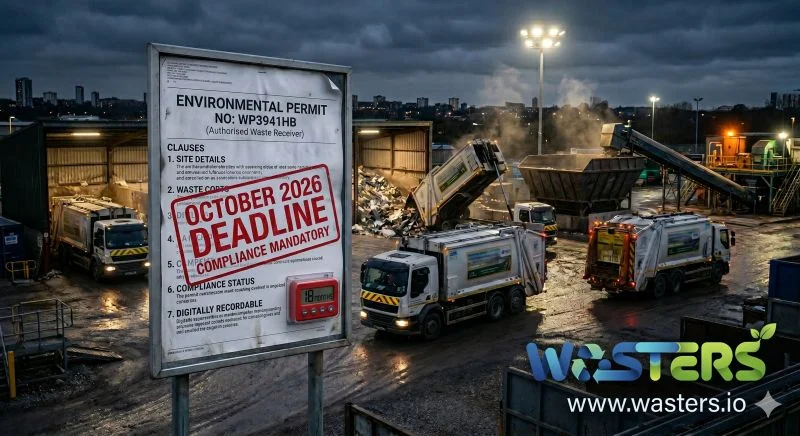
You might be one and not know it.
Dangerously Incomplete Assumptions
You might be one and not know it.
There's a comfortable assumption spreading through the carrier community right now: "We're a carrier. October 2026 is for receiving sites. We've got until October 2027. We can relax."
It's a reasonable reading of the legislation. It's also dangerously incomplete.
The definition of a "waste receiving site" isn't about what you call yourself. It's about whether your site operates under a permit or licence to receive waste. If it does, you are a receiver. In October 2026. Regardless of what else you do.
Common Scenarios We Are Seeing
The scenarios we're seeing:
🔴 The Demolition Contractor with a Permitted Yard. Your teams strip out a commercial building. Mixed loads of timber, concrete, metal and plasterboard come back to your yard at the end of each day for sorting before onward disposal. Your yard holds a permit. Waste is arriving at a permitted site. You are a receiver.
🔴 The Skip Hire Operator with a Transfer Station You collect skips from customers across a region. The skips return to your depot where they've tipped, sorted and consolidated before going to a disposal facility. That depot is a licensed transfer station. Every skip that tips there is a waste receipt. You are a receiver.
🔴 The Waste Carrier with an Intermediate Bulking Facility You collect from multiple smaller producers — restaurants, offices, retail units — and bring loads back to your own facility before bulking them up for a single run to a processor. That facility operates under an environmental permit. You are a receiver.
🔴 The Construction Logistics Company Running a Consolidation Hub You manage waste across a large construction project. Subcontractors bring mixed waste to your on-site hub before it's classified and removed by type. If that hub operates under any form of permit or licence, every movement into it is a digitally recordable receipt from October 2026.
Is Your Site Licensed?
The question is not "do we think of ourselves as a receiver?"
The question is: does your site hold a permit or licence to receive controlled waste?
If yes — regardless of your primary business, regardless of whether the waste is your own or someone else's — you are in scope for October 2026. Sites covered by Waste Exemptions or Standard Rules are not in scope for the October 26 deadline but they are coming into range quickly so don’t leave your planning too late.
A permitted site with no digital records will be a red flag to the Environment Agency.
Pull out every permit and licence you holds and ask: does this authorise the receipt of controlled waste? If the answer is yes, you are not "just a carrier." You are also a receiver — and the clock is running.
If you're unsure how to read your permit, speak to your environmental consultant or solicitor. And if you'd like a second pair of eyes from people who live and breathe this legislation every day, we're happy to give you a straight answer on where you stand. Just drop us a message.
Is your system ready for October 2026?
Don't leave digital waste compliance to vague supplier commitments. Verify your path forward with a focused compliance layer built for the DEFRA API.
Read Next
The Looming Waste Tech Bottleneck: Why Site Connectivity Just Became Mission-Critical
For years, waste receiving sites had a straightforward approach to IT infrastructure: local resilience was king. The upcoming DEFRA DWT mandate changes the game entirely.
We need to talk about the fear-mongering currently happening in our sector.
In recent conversations with waste operators and compliance managers, the anxiety surrounding DEFRA’s October 2026 digital waste tracking mandate is palpable. And honestly? It’s completely understandable.
The October 2026 DEFRA Digital Waste Tracking deadline is forcing software decisions that were probably overdue anyway.
Most receiving sites we speak to fall into one of three categories. Which one are you? Learn how to navigate the upcoming Section 58 mandate.