Compliance20 June 20267 min

EWC Codes Explained: A Practical Guide to UK Waste Classification (and Why They Matter More Under Digital Tracking)

Mal Rigoli

Mal Rigoli

Co-Founder, Wasters

EWC Codes Explained: A Practical Guide to UK Waste Classification (and Why They Matter More Under Digital Tracking)

Every Waste Transfer Note issued in the UK carries one small piece of data that does an outsized amount of legal work: the EWC code. Under DEFRA's Digital Waste Tracking service, accuracy moves from a paperwork habit to an operational dependency.

What Is an EWC Code?

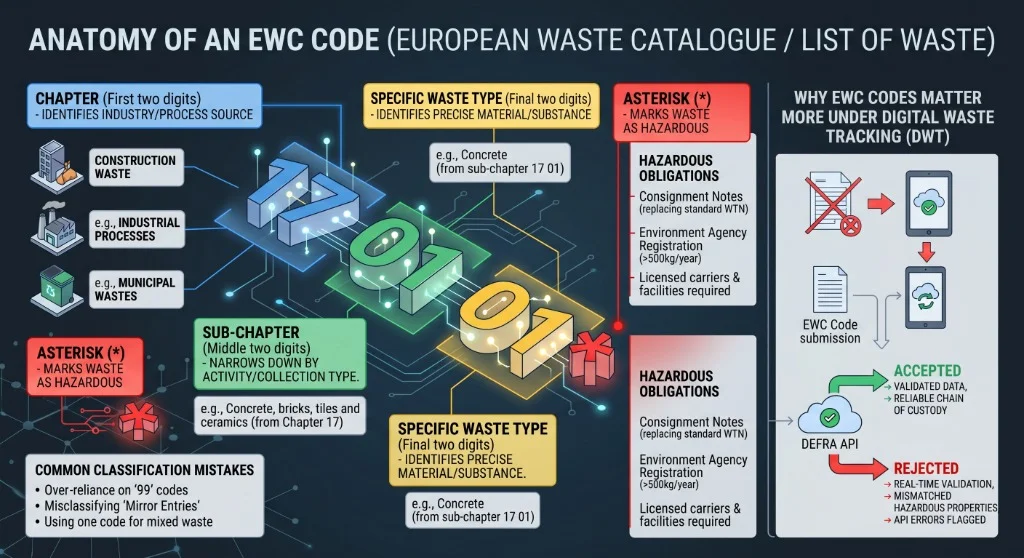
An EWC (European Waste Catalogue) code is a six-digit number that classifies a specific type of waste. The Environment Agency also refers to it as a LoW code (List of Waste) — the two terms are used interchangeably and refer to the same classification system. The catalogue originates from EU Commission Decision 2000/532/EC and was retained in UK law following Brexit. It covers well over 800 individual waste descriptions, though in practice most businesses only ever need a handful of codes that recur across their regular waste streams. Using the correct code isn't optional. It's a legal requirement under Duty of Care legislation, which obliges anyone who produces, carries, or disposes of waste to describe it accurately enough that it can be handled and managed safely at every stage of its journey.

How the Classification System Is Structured

The EWC list is organised hierarchically, and understanding the structure makes finding the right code far quicker: Chapter (first two digits) — identifies the industry, process, or source the waste came from. Construction waste sits in one chapter, municipal and household waste in another, packaging in another again. Sub-chapter (middle two digits) — narrows the waste down by activity or collection type within that chapter. Specific waste type (final two digits) — identifies the precise material or substance. Codes ending in 99 mean "wastes not otherwise specified." They exist as a last resort for genuinely unclassifiable material, not as a default when the right code is inconvenient to find. Over-reliance on 99 codes is one of the most common — and most avoidable — classification errors, and it's an easy one for any system checking your data to flag.

Hazardous Waste and the Asterisk

Some codes in the catalogue carry an asterisk (*). This marks the waste as hazardous, which brings a separate set of legal obligations: registration with the Environment Agency if you produce more than 500kg of hazardous waste a year, consignment notes rather than standard Waste Transfer Notes, and a requirement to use carriers and facilities licensed for hazardous material. A detail that catches people out: many waste types appear twice in the catalogue — once with an asterisk, once without. These are known as mirror entries. The same physical waste stream (insulation material is a common example) can be classified as hazardous or non-hazardous depending on the concentration of dangerous substances actually present. Choosing the wrong half of a mirror pair isn't a paperwork slip; it's a misclassification with real legal weight, since it determines which handling regime applies.

Why EWC Codes Carry More Weight Under Digital Waste Tracking

Under the paper WTN system, an EWC code was, in practice, often the least scrutinised field on the form. Someone wrote it down, it got filed, and unless an inspection or dispute surfaced it, it sat there unchecked. That's the part of the system DEFRA's Digital Waste Tracking service is built to close. From October 2026, waste receiving sites must log digital records of what they receive — and those records flow through an API designed to validate them on the way in, not years later when someone goes looking. Submissions are checked for whether the hazardous properties claimed actually match the EWC code selected, and mismatched or implausible combinations get flagged rather than quietly accepted. Receivers themselves become responsible for validating the movements they record, including the codes carriers and brokers supply upstream. This is really a symptom of a bigger shift. The waste industry has spent decades treating physical infrastructure — sites, vehicles, weighbridges — as the thing that mattered, with the paperwork trailing along behind as an afterthought. Digital tracking inverts that. The movement of waste now generates a structured, permanent data record, and that record is only as trustworthy as the classification decisions feeding into it. An EWC code that's wrong doesn't just risk a fine anymore. It breaks a link in a chain-of-custody dataset that regulators, and increasingly your own counterparties, will be relying on.

Common Classification Mistakes — and How They Compound Under DWT

A handful of errors account for most of the EWC problems that surface in audits and, soon, in API rejections: Defaulting to a 99 code instead of taking the time to find the specific entry that actually applies. Assuming a waste is non-hazardous without assessing composition against threshold concentrations, particularly on mirror-entry waste streams where the non-hazardous code is the easier-looking option. Using one code for mixed waste stored in a single container, when the material is genuinely a blend that requires separate codes. Hazardous property mismatches — selecting an EWC code that doesn't align with the hazardous properties actually declared elsewhere on the record. Under paper-based compliance, these errors often went unnoticed until an audit. Under a system that validates submissions as they're made, they surface immediately — as rejected records, queried loads, and breaks in a digital trail that's designed to be continuous.

How to Find the Right EWC Code

Identify the source. Where did the waste come from — an industrial process, construction activity, packaging, or general municipal waste? This determines the chapter. Narrow to the sub-chapter. Within that chapter, identify the specific activity or collection type. Match the precise description. Find the entry that most specifically describes the material — not the closest-sounding one. Check hazard status against composition, not assumption — particularly for anything with a mirror entry. Escalate when uncertain. EWC classification can be genuinely complex. The Environment Agency's List of Waste guidance is the authoritative reference, and a qualified waste management consultant is worth involving for anything ambiguous or high-risk. This is general guidance rather than a substitute for that official guidance — classification carries legal liability, and getting it right matters more than getting it fast.

Frequently Asked Questions

Is an EWC code the same as a LoW code? Yes. The Environment Agency uses "LoW code" (List of Waste) and "EWC code" interchangeably — they refer to the same six-digit classification system. Do I still need an EWC code under Digital Waste Tracking? Yes, and it matters more, not less. The same classification requirement carries over from paper WTNs, but DWT validates the code against other submitted data in real time rather than leaving it unchecked until an audit. What does the asterisk on an EWC code mean? It marks the waste as hazardous, which triggers separate legal requirements — consignment notes instead of a standard WTN, registration with the Environment Agency above certain thresholds, and licensed carriers and facilities. What's a mirror entry? A waste type that appears twice in the catalogue — once hazardous, once not — where the correct code depends on the actual concentration of dangerous substances present, not an assumption either way.

Getting Ready for October 2026

Waste receiving sites face the first Digital Waste Tracking deadline in October 2026, with carriers and brokers following in October 2027. For receiving sites in particular, EWC code accuracy is about to move from a compliance checkbox to an operational dependency — because the system validating your submissions won't accept the workarounds a paper form quietly tolerated. The compliance obligation itself isn't the most interesting part of this shift. What matters more is that, for the first time, waste classification data will be structured, queryable, and connected end-to-end — which means accurate EWC coding stops being a defensive habit and starts being an asset: the foundation of a dataset you can actually use to understand your own waste streams, not just report on them. If you're a waste receiving site preparing for the October 2026 deadline, getting your classification data right before the mandate lands — rather than during it — is the difference between a smooth transition and a backlog of rejected records. Wasters is built around exactly this: DEFRA API-tested software that validates waste data, including EWC and hazardous property combinations, before it's submitted — not after it bounces back.

Is your system ready for October 2026?

Don't leave digital waste compliance to vague supplier commitments. Verify your path forward with a focused compliance layer built for the DEFRA API.

Read Next