Compliance29 March 20264 min

Most people in the waste industry are talking about October 2026 as a systems problem. Install new software. Job done.

Mal Rigoli

Mal Rigoli

Co-Founder, Wasters

Most people in the waste industry are talking about October 2026 as a systems problem. Install new software. Job done.

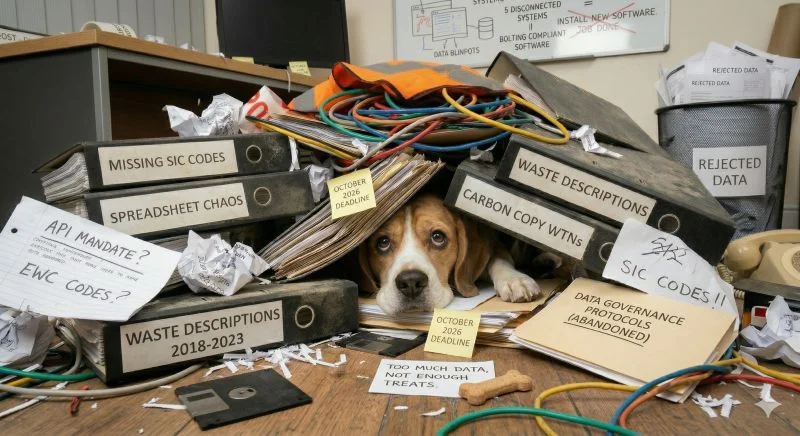
But after working closely with our pilot customers at Wasters, I can tell you the real problem is much more fundamental — it's a data problem.

A Systems Problem vs. A Data Problem

Most people in the waste industry are talking about October 2026 as a systems problem. Install new software. Job done. But after working closely with our pilot customers at Wasters, I can tell you the real problem is much more fundamental — it's a data problem. Defra's Digital Waste Tracking mandate requires every waste movement at permitted and licensed sites to be logged digitally, validated against EWC codes, and submitted to a central government API in near real-time. The Environment Agency will have live visibility of every waste movement — no more waiting for inspections. That sounds straightforward. Until you look at what companies actually have: here's the thing nobody wants to say out loud: you can't bolt a compliant digital system onto messy, inconsistent data and expect it to work. The API will reject it.

The 6 Data Blind Spots Killing Compliance

Here are the 6 data blind spots killing compliance before it even starts: 🔴 Company Names: "Smiths Yard" won't cut it when the legal entity is "Smiths and Sons Waste Centre Limited." 🔴 Addresses: "100 High Road" isn't enough. You need the exact, complete address and postcode. 🔴 SIC Codes: Do you have the correct Standard Industrial Classification (SIC) code for every customer? You can't guess their industry — the digital waste note requires the exact code for the business producing the waste. For limited companies, this is the code registered at Companies House. 🔴 EWC Codes: Just because you're collecting from a restaurant doesn't mean you use a standard municipal waste code. If they've had a refit and you're hauling demolition material, you need the specific EWC code for that exact waste type. Defaulting to one code per customer will result in rejected submissions. 🔴 Inconsistent Standards: It's no good having team members working off completely different lists of EWC codes for the exact same waste streams. 🔴 Local Authority Mapping: Your legacy spreadsheet becomes unmanageable when you suddenly need to map messy address data to precise Local Authority districts to prepare your returns.

Start Your Data Cleanup Now

There is a dangerous assumption that a software update will fix all of this. It won't. Clean data going into a new system requires clean data to exist in the first place. If you don't have your data organised in a spreadsheet, start there. If you do, start cleaning it and aligning everything with the full, correct details. No shortcuts. Fines for non-compliance could reach £5,000 per incident — and with real-time regulatory visibility, there's nowhere to hide. The businesses that will be ready in October 2026 are the ones starting their data cleanup now — not in Q3. If you're in waste management, sustainability, or compliance: when did you last audit your waste data quality?

Is your system ready for October 2026?

Don't leave digital waste compliance to vague supplier commitments. Verify your path forward with a focused compliance layer built for the DEFRA API.

Read Next