Compliance6 May 20264 min

Digital Waste Tracking Is Coming in October. Do You Want to Comply — or Compete?

Mal Rigoli

Mal Rigoli

Co-Founder, Wasters

Digital Waste Tracking Is Coming in October. Do You Want to Comply — or Compete?

You've been through this before and you know how it goes — most people leave it too late.

Lessons from Making Tax Digital

You've been through this before and you know how it goes — most people leave it too late. For most businesses, digital tax isn't new. Making Tax Digital for VAT has been mandatory since 2022. And from April 2026, the net tightens further — sole traders earning above £50,000 must now submit quarterly digital updates to HMRC, with lower thresholds following in 2027 and 2028. And yet 39% of sole traders still haven't started preparing — for a mandate that has been signposted for years. In waste, the situation is considerably worse. A few days ago DEFRA confirmed the mandatory digital waste tracking legislation. For anyone still hoping it might be delayed or watered down — that conversation is over.

The Six-Month Warning

From October 2026, every permitted receiving site must record every waste movement digitally — live, accurate, visible to regulators in real time. Carriers, brokers and producers follow in 2027. But many operators still don't understand how it applies to them. Some don't know they're in scope at all. That isn't a criticism. The legislation is complex. But October 2026 is six months away.

The Compliance Floor vs. Strategic Edge

The compliance floor Both mandates have a minimum viable response — software that does just enough to keep the regulator off your back. Hit the deadlines, file the data, move on. Job done. But here's the thing about the compliance floor: everyone is standing on it. Businesses built on the lowest common denominator don't tend to pull away from their competitors. The businesses that look back on 2026 as a turning point won't be the ones that found the cheapest way to comply. They'll be the ones that asked: Now that we're capturing this data anyway — what can we do with it? Digital waste tracking doesn't just satisfy the Environment Agency. It gives you a real-time picture of every tonne you move — by site, by waste type, by customer, by route. Which collections are profitable? Which routes are inefficient? Which waste streams have value you're not capturing? You are going to spend time and money on this regardless. The only question is what you do with what you build.

Runway or Waiting Room?

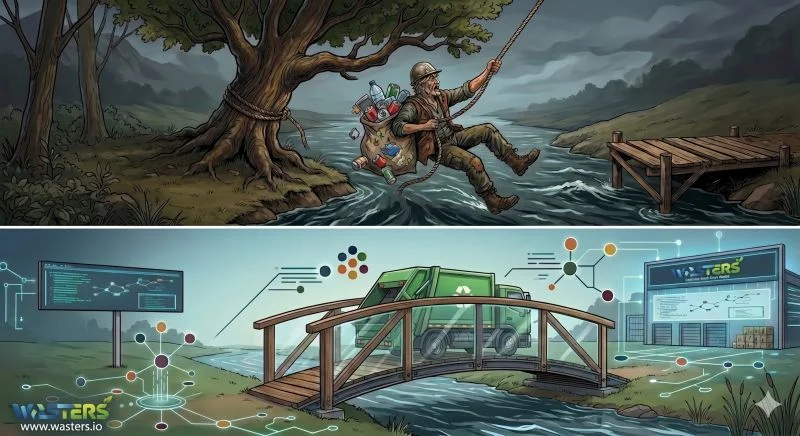
The minimum — compliant records and nothing else — will feel like a burden and deliver no return beyond avoiding a fine. The foundation — a digital infrastructure designed around visibility, control and insight — turns a legal obligation into a competitive edge. The businesses that treat 2026 as a compliance year will still be talking about going digital in 2030. The ones that treat it as a transformation year will have already moved on. That gap — between where the legislation is and where industry understanding is — is the real risk of 2026. Not the technology. Not the cost. The assumption that it probably doesn't apply to you, or that there will be time to catch up later. There won't be. But there is still time to get ahead of it. The question is whether you treat that time as a runway or a waiting room.

Is your system ready for October 2026?

Don't leave digital waste compliance to vague supplier commitments. Verify your path forward with a focused compliance layer built for the DEFRA API.

Read Next